



The timeless beauty of Dia Tang Phi Lai pagoda
Ha Nam, a
low-lying area at the southern gateway to Hanoi capital city, boasts a
pleasant climate and abundant natural beauty. Not only famous for its
long-standing cultural heritage, Ha Nam is also frequently mentioned for its
spiritual system, with four renowned temples: Tam Chuc, Ba Danh, Phat Quang,
and Dia Tang Phi Lai. Seemingly forgotten by time, the Dia Tang temple has
now donned a new look, attracting numerous visitors from all over to worship
and admire the scenery. The serene atmosphere at the temple, the peaceful
and simple beauty, brings a sense of peace to the heart, as if untouched by
worldly concerns - Tailor-made Vietnam tours
Dia Tang Phi Lai pagoda, also known colloquially as Dung Pagoda, derives its
name from the ancient name Dung of Ninh Trung village in Liem Son commune,
Thanh Liem district, Ha Nam province. Locals still recount that the pagoda
was built in the 11th century with over 100 rooms. In the past, King Tran
Nghe Tong chose the pagoda as his retreat, and King Tu Duc also visited it
to pray for a son.
To date, the temple is nearly a thousand years old, gradually deteriorating
and wearing down over time. It wasn't until the end of 2015 that Venerable
Thich Minh Quang took over, renovated it, and renamed it Dia Tang Phi Lai Tu
(Ksitigarbha Bodhisattva), implying that Bodhisattva Ksitigarbha came to
this place, attained Buddhahood, and will not return. The ancient temple is
situated on a hill overlooking vast rice fields, with its back against a
pine forest, surrounded by nature on all four sides. Perhaps this is part of
the reason why the temple was abandoned for a long time, remaining isolated
and overgrown before being renovated and becoming known to tourists today.
How to get there
Dia Tang Phi Lai pagoda in Ha Nam is located 16km from Phu Ly city, the
center of Ha Nam province, and 72.5km from Hanoi, a 1 hour and 21 minute
drive south. Therefore, I suggest two convenient routes for both cars and
motorbikes as follows:
Getting to Dia Tang Phi Lai Pagoda by car: Starting from Hanoi, take the Cau
Gie - Ninh Binh expressway to Phu Ly, Ha Nam via National Highway 1A. From
there, drive straight for another 12km to reach the pagoda; the journey
takes about 1.5 hours.
To get to Dia Tang Phi Lai Pagoda by motorbike: Hanoi -> Nuoc Ngam Bus
Station -> drive straight on the old National Highway 1A -> Van Dien ->
Thuong Tin -> Van Diem Train Station -> Phu Xuyen -> Cau Gie -> Phu Ly city
towards Provincial Road 495 to reach the pagoda -> Dia Tang Pagoda.
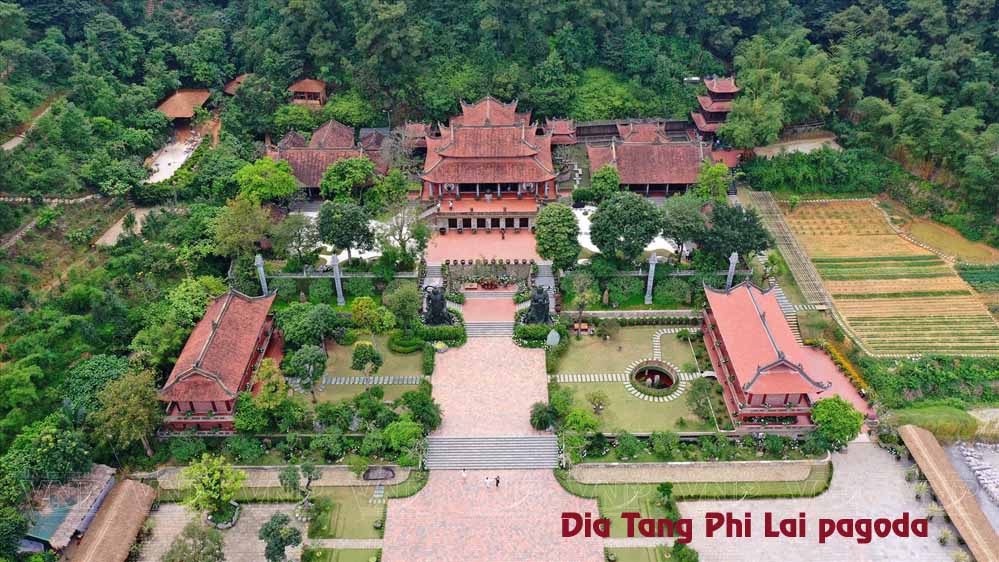
Dia Tang Phi Lai Pagoda is a surprisingly harmonious blend of structures and
nature. Behind it lies a forest, beside it a small, calm pond, and within
the temple grounds are flowers and trees commonly planted in sacred spaces.
Not ancient and moss-covered, the temple, with its deep brown hue, evokes a
sense of serenity and transcendence in this earthly realm. Free from noise
and dust, far from the hustle and bustle of the city, devotees and travelers
alike have the opportunity to find peace, immersing themselves in nature and
the beauty of the landscape. All that remains is the scent of incense
carried on the breeze, the sound of the temple bells, and the rhythmic
chanting of prayers, all of which bring a sense of inner peace.
The Sea of Suffering and the Twelve Circles: Passing through the gate into
the temple courtyard, visitors will be surprised by the pristine white
expanse before their eyes. Instead of the red brick paving found in most
temples, the ground at Dia Tang Temple is covered ith white pebbles. Beside
the courtyard stands a sign that reads "Sea of Suffering". Twelve circles
drawn on the pebbles in front of the main hall symbolize the twelve links of
dependent origination, with the pebbles representing meditation. All of this
is evidence of and closely connected to Buddhism.
The temple complex: Like most temples and pagodas in the Northern Delta
region, Dia Tang Pagoda is built in the traditional column and gable roof
style, with intricately carved details. The main hall (Tam Bao) is the
largest structure in the temple, dedicated to the Bodhisattva Ksitigarbha.
To the right is the Ancestral Hall, where the 42 founding abbots of the
pagoda are worshipped. Next to it are a small shrine dedicated to the
Bodhisattva Avalokiteshvara, the Venerable Master, and the Holy Sages;
living quarters for monks, nuns, and lay Buddhists; a lecture hall for daily
sermons by the abbot and for meditation retreats; and finally, a guesthouse
for visitors and those participating in retreats and other experiences at
the pagoda.
Admire the artifacts of the Ly-Tran dynasties: The pagoda currently
preserves nearly 100 earthenware, porcelain, and terracotta artifacts with
diverse colors and patterns, identified as artifacts from the Tran dynasty,
with a few patterns from the Ly and Le dynasties. Among them are many types
of bricks and tiles carved with lotus flower, dragon, and phoenix motifs,
along with two sets of mythical creatures recreating historical events from
the Ly-Tran dynasties.
The path to the mountaintop: conquering the temple's peaks along the stream
requires great perseverance from the traveler. Sections are climbed using
ropes, others involve crouching and crawling through caves, and there are
nearly 20 rest stops along the way. The meditation gardens are paved with
white stones or covered in green grass, offering spaces for enjoying tea,
relaxing in hammocks, or sitting on benches to admire the temple from above.
At the summit of Phi Lai Mountain stands the Pho Dong Tower, erected during
the Ly-Tran dynasties, the resting place of 40 generations of abbots.
Dia Tang Phi Lai Pagoda, a sacred place, has become an integral part of the
lives of the people of Ninh Trung and Liem Son, and a spiritual destination
for visitors from all over. Every first and fifteenth day of the lunar
month, as well as on Buddhist holidays, people come to the temple to offer
incense and pray for peace and health, a habit and tradition that has lasted
for many years.
Source:
Dia Tang Phi Lai pagoda a thousand year legacy